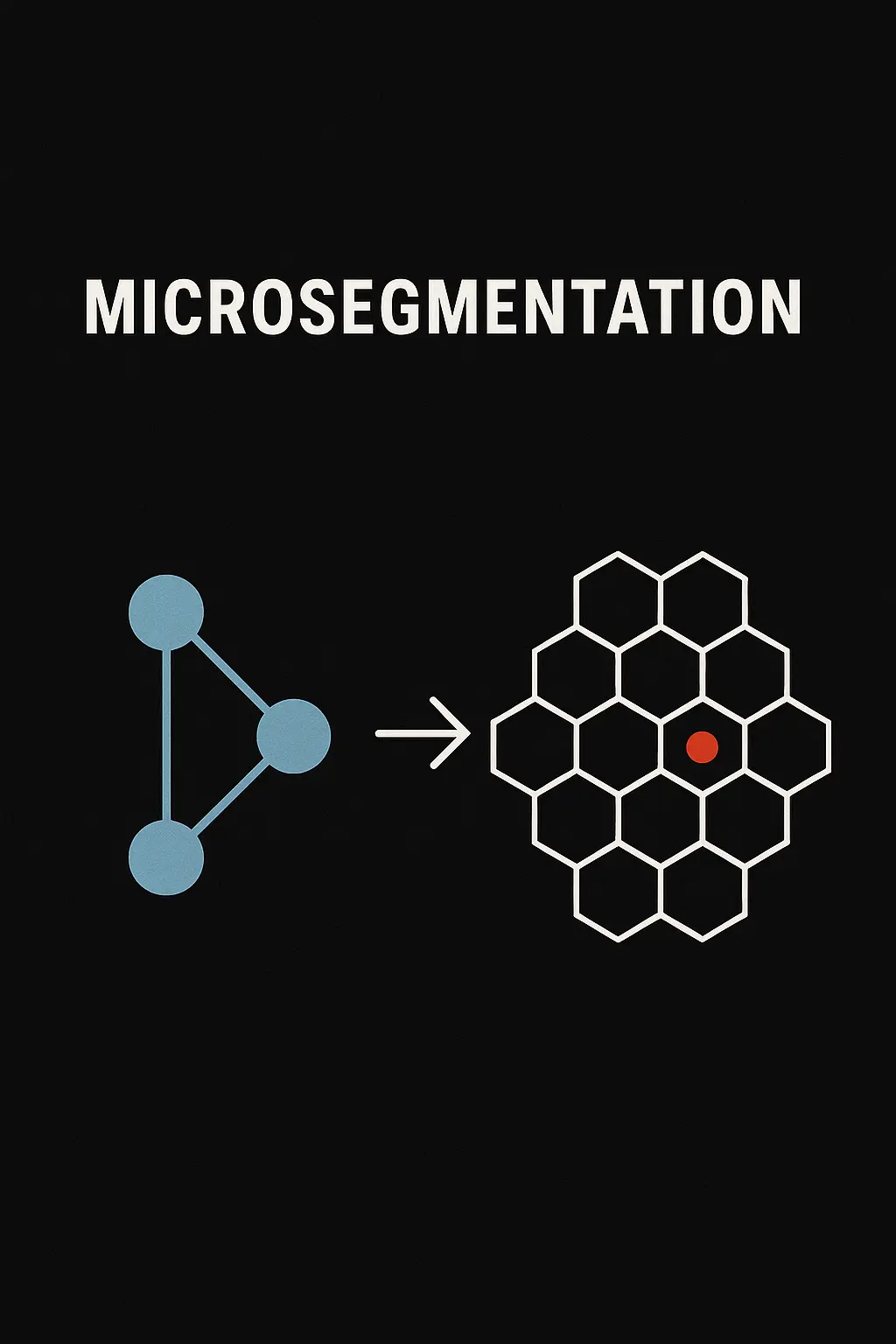
In the ever-evolving landscape of cybersecurity, one of the most persistent challenges is containing an attacker after the initial breach. The headlines are filled with stories of minor intrusions escalating into catastrophic data breaches. The common thread? Unfettered lateral movement. While many organizations have robust perimeter defenses, a shocking 95% are missing a critical internal control: microsegmentation.
This isn’t just another buzzword; it’s a fundamental shift in how we approach network security and a cornerstone of any effective Zero Trust architecture. As part of the CISSP’s Communication and Network Security domain, understanding and implementing microsegmentation is no longer optional, it’s an imperative for survival in the modern threat environment.
The Old Way: Traditional Network Segmentation
For decades, the standard approach to network security has been segmentation. Using Virtual LANs (VLANs), subnets, and internal firewalls, we divide the network into broad zones. Think of it as a castle with a very strong outer wall. The goal is to separate major areas like the corporate network from the development environment, or the production servers from user workstations.
This model does a reasonably good job of controlling “north-south” traffic, which is data flowing in and out of the network. However, once an attacker compromises a single machine within one of these broad segments, they can often move freely within that zone to find and exfiltrate high-value assets. This “east-west” traffic is notoriously difficult to control with traditional methods, leaving a massive gap in our defenses.
Every major breach follows a similar pattern: initial compromise, then lateral movement to reach critical assets.
Enter Microsegmentation: A Paradigm Shift
Microsegmentation changes the game by extending the principles of segmentation down to the individual workload or application level. Instead of a few large, protected zones, you create thousands of software-defined micro-perimeters, each with its own precise access controls. The goal is to enforce a default-deny posture where communication is blocked unless it is explicitly allowed.
This granular approach effectively cripples an attacker’s ability to move laterally. If a web server is compromised, microsegmentation policies would prevent it from communicating with anything other than its specific application-tier server and database—and nothing else. The attacker is trapped within a tiny, isolated segment, unable to scan the network, discover other assets, or escalate their attack.
Key Differences
| Feature | Traditional Segmentation | Microsegmentation |
|---|---|---|
| Granularity | Broad zones (VLANs, subnets) | Individual workloads/applications |
| Enforcement | Network hardware (Firewalls, Routers) | Host-based agents, software-defined |
| Focus | North-South traffic | East-West traffic |
| Agility | Static and difficult to change | Dynamic and highly automated |
Getting Started: A Practical Guide to Implementation
The primary barrier to adopting microsegmentation isn’t desire, it’s implementation complexity. A poorly planned rollout can disrupt critical business operations. However, a phased, strategic approach can lead to a successful deployment.
1. Map Application Dependencies
Before you can write a single policy, you must understand how your applications communicate. What ports does the web server need to open to the app server? What database connections are legitimate? Use tools that can monitor and visualize these traffic flows. This critical first step provides the blueprint for your security policies. Without it, you’re flying blind.
2. Start with Your Crown Jewels
Don’t try to boil the ocean. Identify your most critical assets, the “crown jewels” of your organization and start there. This could be your domain controllers, primary databases, or critical business applications. Protecting these assets first provides the most significant and immediate reduction in risk.
3. Implement Gradually with Monitoring
A “rip and replace” approach is a recipe for disaster. Begin by deploying microsegmentation policies in a monitoring-only or logging mode. In this mode, policies are evaluated, and violations are logged, but no traffic is actually blocked. This allows you to test and refine your rules without causing outages. Once you are confident that your policies accurately reflect legitimate traffic, you can switch to active enforcement.
4. Leverage Automation
In a dynamic cloud or containerized environment, manually creating and managing thousands of firewall rules is impossible. Modern microsegmentation platforms integrate with orchestration tools and leverage automation to create policies based on workload attributes, tags, and other metadata. As a new workload is spun up, the correct security policy is automatically applied. Manual policy creation simply doesn’t scale.
yaml
# Example of a declarative policy using metadata tags
apiVersion: security.io/v1
kind: NetworkPolicy
metadata:
  name: api-access-policy
spec:
  # Apply this policy to pods with the 'app=database' label
  selector:
    matchLabels:
      app: database
  # Define ingress (incoming) rules
  ingress:
  - from:
    # Allow traffic ONLY from pods with the 'app=api-server' label
    - podSelector:
        matchLabels:
          app: api-server
    # On this specific port
    ports:
    - protocol: TCP
      port: 5432
This YAML snippet illustrates how a policy can be defined based on application labels rather than static IP addresses.
Case Studies in Containment: What If?
Imagine if major breaches like the Colonial Pipeline ransomware attack or the SolarWinds supply chain compromise had run into a microsegmented network.
In both cases, attackers gained an initial foothold and then moved laterally for weeks or months, mapping networks and escalating privileges. With microsegmentation, their initial access would have been a dead end. The compromised entry points would have been isolated, unable to communicate with other parts of the network. The blast radius would have been contained from a nationwide crisis to a minor, manageable security event.
Conclusion
While traditional perimeter defenses are still necessary, they are no longer sufficient. The modern threat landscape demands a defense-in-depth strategy that assumes a breach will happen and focuses on containing it. Microsegmentation is arguably the single most effective control for preventing lateral movement and is an essential component of a genuine Zero Trust security posture.
Are you part of the 5% who have implemented this critical control? If not, the time to start your microsegmentation journey is now.
The views expressed in this blog are my own, based on my knowledge, experience, and research. They do not reflect the views of my current or previous employers.