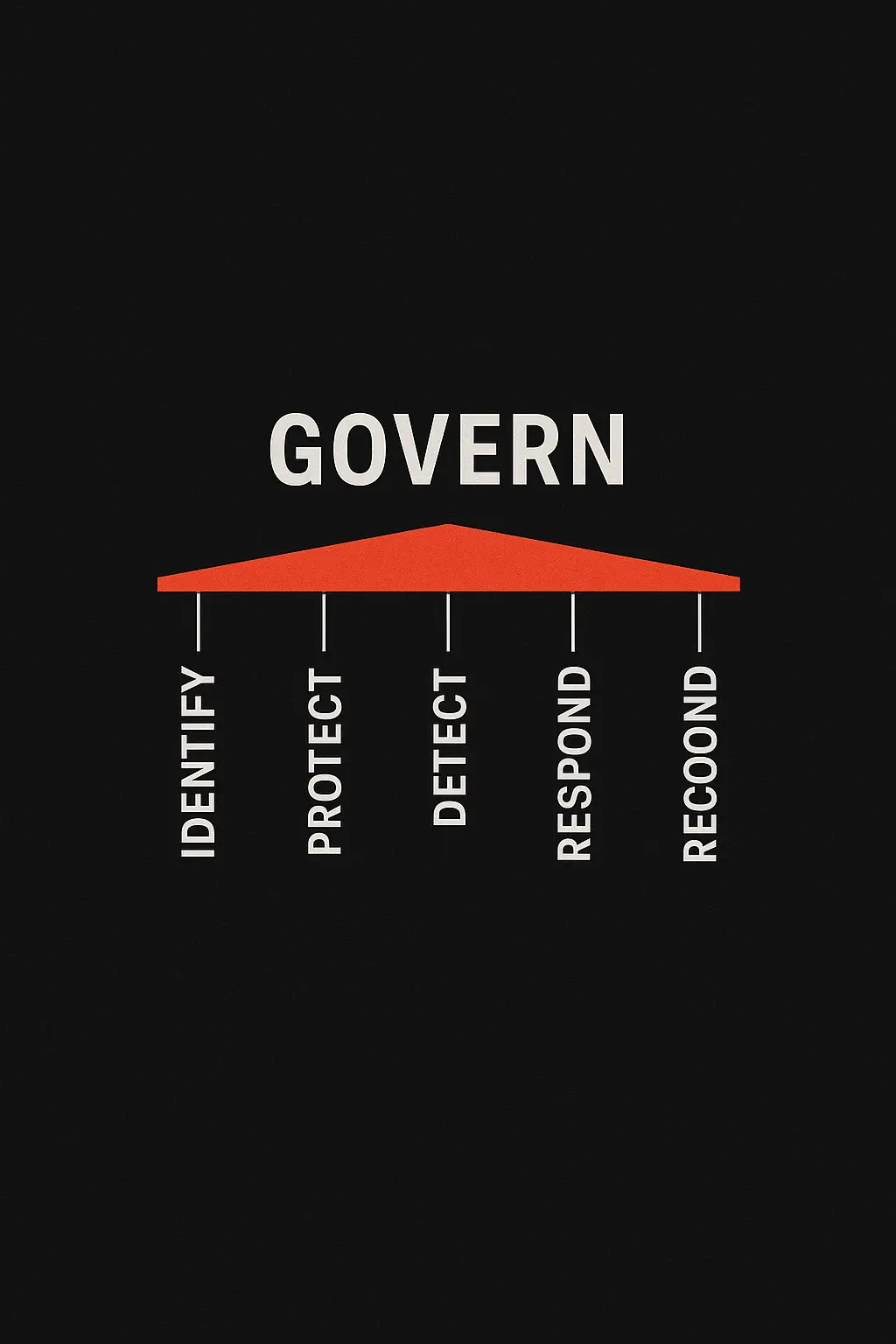
In February 2024, the National Institute of Standards and Technology (NIST) released the Cybersecurity Framework (CSF) 2.0. While it may have seemed like an incremental update to some, this new version introduces a monumental shift that fundamentally changes how we should design and build security programs. The most critical change is the addition of a sixth core function: Govern.
This isn’t just a new category for compliance checklists; it’s an architectural revolution. By elevating governance to the same level as the original five functions—Identify, Protect, Detect, Respond, and Recover—NIST has formally acknowledged a truth that many security architects have known for years: technical controls alone are insufficient. Without a robust framework of governance, our security efforts lack direction, authority, and strategic alignment.
The Core Change: Introducing the “Govern” Function
For years, the NIST CSF has been the gold standard for building a comprehensive cybersecurity program, centered around five key pillars:
- Identify: Understand the organizational context, assets, and risks.
- Protect: Implement safeguards to ensure the delivery of critical services.
- Detect: Implement activities to identify the occurrence of a cybersecurity event.
- Respond: Take action regarding a detected cybersecurity incident.
- Recover: Implement activities to maintain resilience and restore capabilities.
CSF 2.0 places the new Govern function as an overarching layer that informs and directs all the other functions. It focuses on how an organization makes and implements decisions on its cybersecurity strategy.
This isn’t just another compliance checkbox. It’s an architectural revolution that acknowledges what many security architects have known but struggled to formalize.
Governance provides the “how” and “why” behind every security decision. It establishes the rules, roles, and responsibilities that guide the entire security program, ensuring it aligns with the organization’s broader mission and risk appetite.
What “Govern” Means for Your Security Architecture
Treating CSF 2.0 as a simple documentation update is a critical mistake. Recognizing its impact requires a fundamental redesign of our security architecture principles. Here’s what that means in practice.
1. Redrawing Your Architecture Diagrams
Traditional security architecture diagrams are often a sea of network segments, firewalls, servers, and data flows. They excel at showing technical controls but fail to represent the strategic and human elements that actually make them effective.
With the Govern function, your architecture diagrams need a new top layer focused on governance components. This layer should explicitly map out:
- Organizational Context: How cybersecurity strategy aligns with business goals.
- Risk Management Strategy: The processes for identifying, assessing, and responding to risk, including the structure of risk committees.
- Cybersecurity Policy Framework: The hierarchy of policies, standards, and procedures.
- Roles and Responsibilities: Clearly defined ownership of security functions (e.g., using a RACI matrix).
- Oversight and Reporting: Board-level reporting structures and communication pathways for security matters.
2. Expanding the Architectural Boundary
The architectural boundary of your security program is no longer just your technology stack. It now officially extends to include the entire socio-technical system. This means your architecture must account for:
- Human Processes: How are employees trained? How is security awareness integrated into their daily work?
- Oversight Mechanisms: What are the audit and compliance verification processes? How is accountability enforced?
- Third-Party Risk Governance: How does the organization govern the risk introduced by partners, vendors, and the supply chain?
The security architect must now think beyond systems and servers to model the interplay between people, processes, and technology.
3. Bridging the Gap Between Security Architecture and GRC
Historically, security architecture (the “how”) and Governance, Risk, and Compliance (GRC) (the “why”) have often operated in separate silos. Architects designed the technical systems, while GRC teams managed the policies and compliance paperwork.
CSF 2.0 demolishes this silo. The framework makes it clear that controls and policies must be designed and implemented under a single, unified structure. Security architects must collaborate more closely than ever with GRC teams to ensure that technical control implementations are a direct expression of the governance objectives. This fusion requires a shared language, integrated processes, and a common understanding of risk from the server rack to the boardroom.
A practical example might involve representing security policies as code, which can be version-controlled, tested, and audited, directly linking the GRC policy to its technical implementation.
# Example: Policy-as-Code for an S3 Bucket
AWSTemplateFormatVersion: '2010-09-09'
Description: A secure S3 bucket compliant with our data protection policy (POL-DATA-001).
Resources:
  SecureDataBucket:
    Type: 'AWS::S3::Bucket'
    Properties:
      BucketName: 'my-company-secure-data-bucket'
      AccessControl: Private
      PublicAccessBlockConfiguration:
        BlockPublicAcls: true
        BlockPublicPolicy: true
        IgnorePublicAcls: true
        RestrictPublicBuckets: true
      VersioningConfiguration:
        Status: Enabled
      BucketEncryption:
        ServerSideEncryptionConfiguration:
          - ServerSideEncryptionByDefault:
              SSEAlgorithm: 'aws:kms'
              KMSMasterKeyID: 'alias/aws/s3'
This snippet directly translates a governance requirement (data must be private and encrypted) into an architectural artifact.
Conclusion
The most successful implementations of NIST CSF 2.0 will be those where security architects partner with leadership to redefine governance structures first, and then cascade those changes down into control implementations and technical designs.
The introduction of the Govern function is a powerful validation of a holistic approach to security. It’s a call to action for security architects to elevate their thinking beyond the technical and to design programs that are resilient, strategically aligned, and built on a strong foundation of governance.
Key Takeaways:
- NIST CSF 2.0 is an architectural shift, not just a documentation update.
- The “Govern” function is now a central pillar, providing direction for all other security functions.
- Security architecture must now explicitly include governance components, human processes, and third-party risk.
- Success requires a top-down approach, starting with governance and driving changes down to technical controls.
Have you started adapting your security program for CSF 2.0? It’s time to review your architecture and ask the critical question: where is “Govern” represented?
Suggested Reading
- NIST Cybersecurity Framework 2.0 Official Release
- CSO Online: What’s New in NIST CSF 2.0
- Deloitte: NIST CSF 2.0 Implementation Guide
The views expressed in this blog are my own, based on my knowledge, experience, and research. They don’t reflect my current or previous employers’ views.