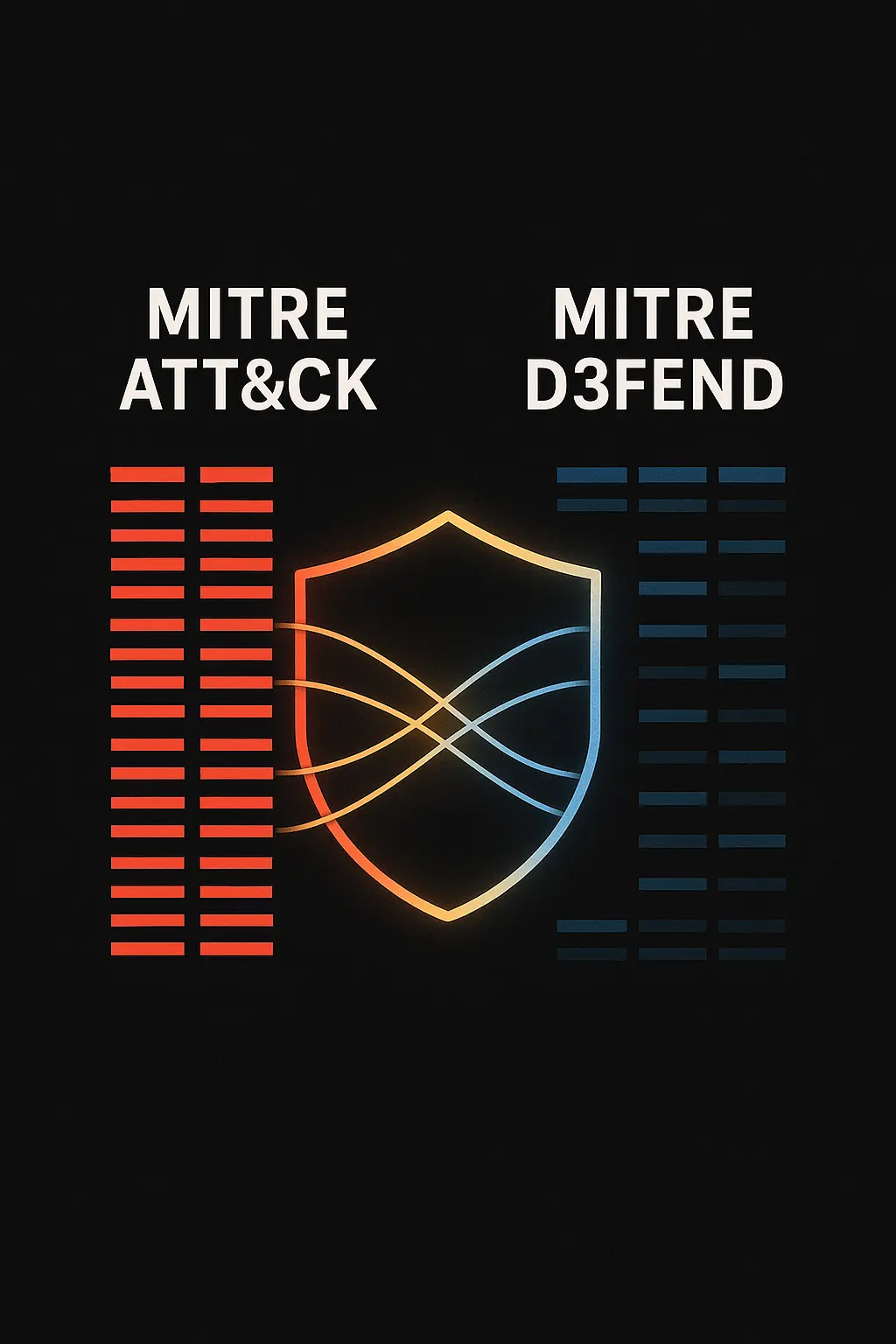
In the world of cybersecurity, the MITRE ATT&CK framework is a household name. It provides an extensive, curated knowledge base of adversary tactics and techniques based on real-world observations. Blue teams and security architects use it to understand how attackers operate, build threat models, and guide their detection strategies. But there’s a critical question that ATT&CK helps you ask, but doesn’t explicitly answer: “We’ve detected this technique… now what?”
This is where many security teams hit a wall. They have impressive detection capabilities and can identify adversary behavior with precision, but they struggle to connect those detections to concrete, effective defensive actions. This is the gap that MITRE D3FEND was created to fill. It’s the defensive counterpart to ATT&CK, designed to close the loop between threat identification and mitigation.
Understanding the ATT&CK and D3FEND Relationship
If you think of ATT&CK as the enemy’s playbook, detailing every possible move they can make, then D3FEND is your defensive playbook. It’s a catalog of countermeasures that directly map to the offensive techniques cataloged in ATT&CK.
Using ATT&CK without D3FEND is like knowing exactly how your opponent will attack but having no pre-planned strategy to counter them. You’re left scrambling to build defenses ad-hoc, often in the heat of an incident. By using the two frameworks together, you can move from a reactive posture to a proactive, layered defense strategy.
The Five Core Defensive Categories of D3FEND
MITRE D3FEND organizes defensive techniques into a logical ontology, with the highest level broken down into five core tactical categories. These provide a structured way to think about and implement countermeasures.
- Harden: These are proactive measures aimed at reducing the attack surface. This involves configuring systems and services to be more secure by default, making it harder for an attacker to gain an initial foothold or exploit vulnerabilities.
- Detect: This category includes all techniques used to identify malicious activity. It aligns closely with what many think of as traditional security monitoring, but D3FEND provides a structured way to think about what to detect and how.
- Isolate: When a potential threat is detected, isolation techniques are used to contain it and prevent it from spreading. This could mean quarantining a file, segmenting a network, or restricting a process.
- Deceive: Deception techniques are used to mislead or misdirect attackers. This can involve setting up honeypots, honeytokens, or other decoys to waste an attacker’s time and reveal their methods without risking real assets.
- Evict: Once an attacker’s presence is confirmed and contained, eviction techniques are used to fully remove them from the environment and restore the system to a known-good state.
Putting D3FEND into Practice: Real-World Scenarios
The true power of D3FEND is its ability to provide specific, actionable defensive recommendations for specific ATT&CK techniques. Let’s look at a few practical examples of how a Security Operations Center (SOC) or blue team can use this mapping.
Scenario 1: Countering Credential Access
An attacker is attempting to escalate privileges using techniques from the Credential Access tactic (ATT&CK TA0006). Your team has detections in place for credential dumping.
- The Question: How do we counter this?
- The D3FEND Answer: D3FEND maps this threat to several defensive techniques, including:
D3-AC: Authentication Controls: Enforcing multi-factor authentication (MFA) and strong password policies.D3-CH: Credential Hardening: Securing where and how credentials are stored, such as using credential vaults and restricting access to sensitive system memory.
Scenario 2: Defending Against Living-off-the-Land (LotL) Attacks
Adversaries are using legitimate system tools like PowerShell or WMI to execute their payload, a common “Living-off-the-Land” approach that falls under the Execution tactic (ATT&CK TA0002).
- The Question: How do we stop attacks that use our own tools?
- The D3FEND Answer: D3FEND suggests countermeasures like:
D3-PA: Process Analysis: Monitoring process lineages and command-line arguments to spot anomalous use of legitimate tools.D3-EP: Execution Prevention: Using application control policies (like AppLocker) or script execution policies to block or constrain the use of tools like PowerShell.
Scenario 3: Disrupting Command & Control
You’ve detected suspicious network traffic that you believe is an attacker communicating with their infrastructure, as described in the Command and Control tactic (ATT&CK TA0011).
- The Question: How can we block this communication?
- The D3FEND Answer: The framework recommends several network-based defenses:
D3-NTA: Network Traffic Analysis: Deep packet inspection and flow analysis to identify anomalous patterns indicative of C2 traffic.D3-OTF: Outbound Traffic Filtering: Implementing strict egress filtering rules on the firewall to block connections to known malicious domains or IP addresses, and potentially restricting all outbound traffic to only what is explicitly allowed.
Conclusion: Build a Complete Security Strategy
MITRE ATT&CK has revolutionized how organizations understand and talk about cyber threats. But understanding the threat is only half the battle. By pairing it with MITRE D3FEND, security teams can build a comprehensive, evidence-based defensive strategy that directly counters the techniques used by adversaries.
Instead of creating security controls in a vacuum, you can use D3FEND to justify and prioritize your defensive measures based on the specific threats you face. It helps answer the “Now what?” question and allows you to build a truly resilient security posture. If your team is using ATT&CK, it’s time to ask how you can integrate D3FEND. The number of teams using both should be higher.