Introduction
In the race to innovate, the term “AI” has become the ultimate buzzword in cybersecurity. Vendors are scrambling to label their products as “AI-powered,” promising revolutionary threat detection and autonomous response. But beneath the slick marketing, a troubling trend has emerged: AI washing. This practice of making exaggerated or misleading claims about AI capabilities is creating a dangerous illusion of security.
This post challenges security leaders to look past the marketing jargon and demand evidence-based solutions. We’ll explore the reality behind these so-called AI tools and provide a practical framework for separating genuine innovation from the new digital snake oil.
The “AI-Powered” Illusion
Controversial but true: a staggering 80% of “AI‑powered” security tools are misleading you. The biggest cybersecurity threat in 2024 isn’t a new strain of malware; it’s the proliferation of legacy tools masquerading as cutting-edge AI.
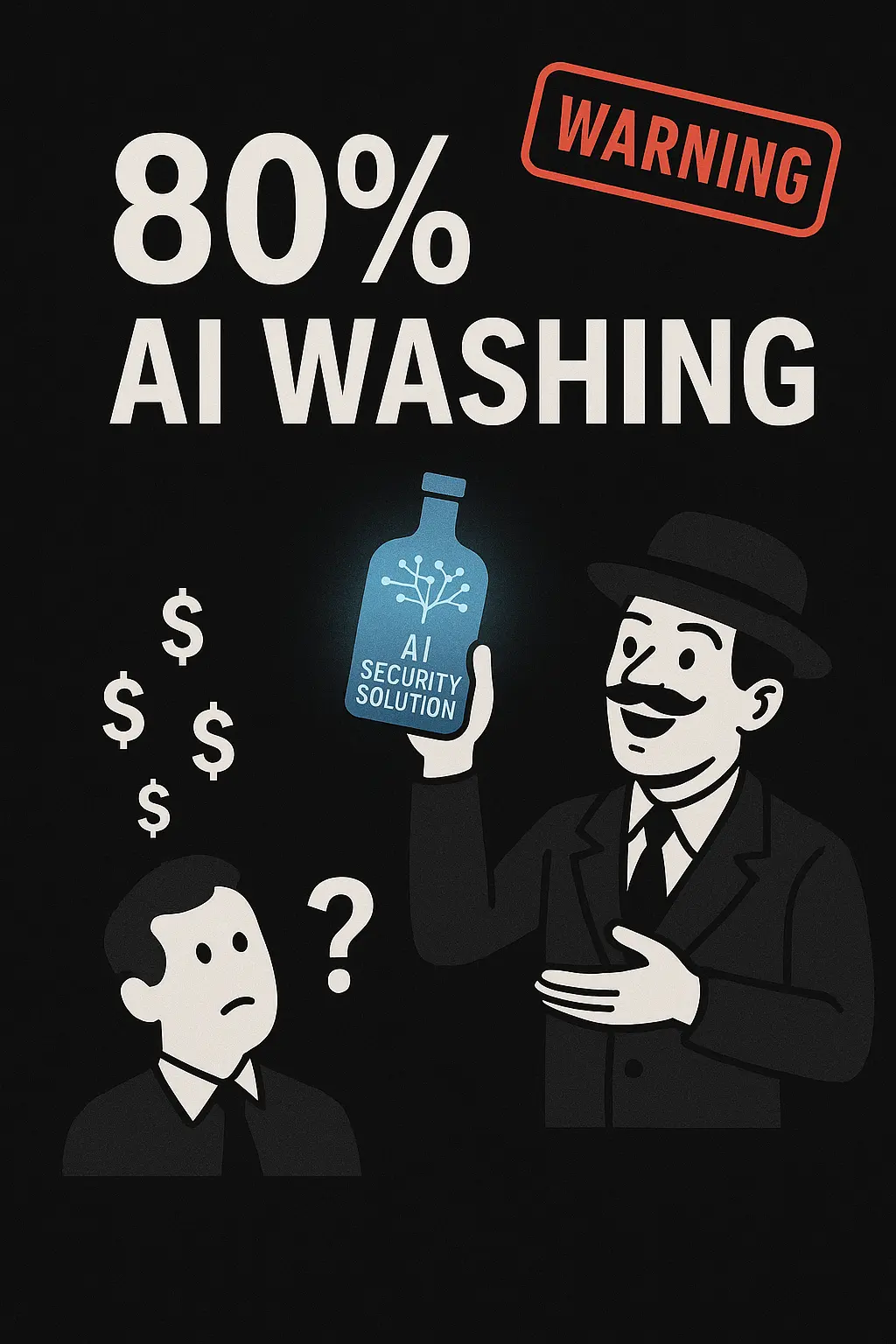
A vendor sells a bottle of “AI Security Solution” to a confused customer, illustrating the concept of AI washing.
From my experience evaluating security solutions over the past year, most fall into one of three buckets:
- Rule-Based Relics: These are traditional, signature-based systems given a modern UI and a fancy “AI” label. At their core, they still rely on static rules and cannot adapt to novel threats.
- Statistical Smoke and Mirrors: Basic statistical models, which have been used in security for decades, are now being rebranded as “machine learning.” While useful, they lack the complexity and learning capabilities of true AI.
- Niche AI Components: Some tools do incorporate genuine AI, but it’s often a minor component solving a very specific problem. Worse, these poorly implemented AI modules can sometimes introduce new vulnerabilities and attack surfaces.
Why Are We Buying the Hype?
Despite the lack of substance, companies continue to sign million-dollar contracts for these solutions. The reasons are often more psychological than technical:
- Executive FOMO: Leaders read about the “AI revolution” in business magazines and fear being left behind.
- The Innovation Theater: Adopting “AI” is seen as a mark of a forward-thinking organization, regardless of its actual effectiveness.
- Vendor Pressure: Aggressive marketing campaigns create a sense of urgency, driving impulse purchases without rigorous vetting.
This trend of “AI washing” isn’t just a marketing nuisance; it wastes budgets, drains resources, and fosters a false sense of security that can leave organizations more vulnerable than before.
How to Cut Through the Noise: A Practical Guide
It’s time to stop throwing cash at buzzwords and start demanding accountability. The next time a vendor pitches you their “AI-powered” solution, arm yourself with these critical questions.
1. What real problem is your AI solving?
Don’t accept vague answers like “it detects threats faster.” Press for specifics. Is the AI designed to reduce false positives in phishing alerts? Does it automate the analysis of malware sandboxing reports? A genuine AI solution should address a well-defined, measurable problem.
Bad Answer
“Our AI provides next-generation threat intelligence.”
Good Answer
“Our machine learning model analyzes inbound email headers and body content to identify and quarantine spear-phishing attempts with a 99.2% accuracy rate, reducing analyst alert fatigue by 40%.”
2. Can I review your training data? How is it relevant to my environment?
An AI model is only as good as the data it’s trained on. A model trained on generic, outdated, or irrelevant data will be useless in your specific environment.
- Ask about data sources: Where did they get their training data? Is it from real-world attacks or sanitized lab environments?
- Ask about data relevance: How does the training data reflect the threats faced by your industry (e.g., healthcare, finance, manufacturing)?
- Ask about data freshness: How often is the model retrained with new data to keep up with emerging threats?
3. What are your production false positive and negative rates?
Every security professional knows that marketing benchmarks are meaningless. Demand real-world performance metrics from production environments similar to your own.
A high rate of false positives can overwhelm your security team, leading to alert fatigue where real threats are missed. Conversely, a high rate of false negatives means the tool is failing to detect actual attacks.
Be wary of any vendor who is hesitant to provide transparent, quantifiable metrics on their model’s real-world performance.
4. Can you demonstrate efficacy against a novel, unscripted threat?
The true test of an AI security tool is not how well it performs in a canned demo but how it responds to the unknown. Challenge the vendor to a proof of concept (POC) that goes beyond their scripted sales pitch.
- Request a live, unscripted demo against a recent, real-world threat sample.
- Run the tool in a test environment against your own red team or a third-party penetration testing service.
- Evaluate not just if it detects the threat, but how it does so. What context and evidence does it provide?
Conclusion
The promise of AI in cybersecurity is real, but it is currently buried under a mountain of marketing hype. As security leaders, it is our responsibility to be skeptical, ask hard questions, and hold vendors accountable. The best security tools—AI or otherwise—are those that deliver measurable impact and solve real-world problems.
Stop buying the buzz. Demand evidence, not promises.
The views expressed in this blog are my own, based on my knowledge, experience, and research. They do not reflect the views of my current or previous employers.
Suggested Reading
- Wikipedia - AI washing: Definition and impact of overstated AI claims.
- Business Insider - Signs and risks of AI washing in security startups: Insights from industry veteran John Fitzpatrick.
- ITPro - ‘Agent washing’: Gartner warns ~40% of agentic AI projects will fail due to hype.